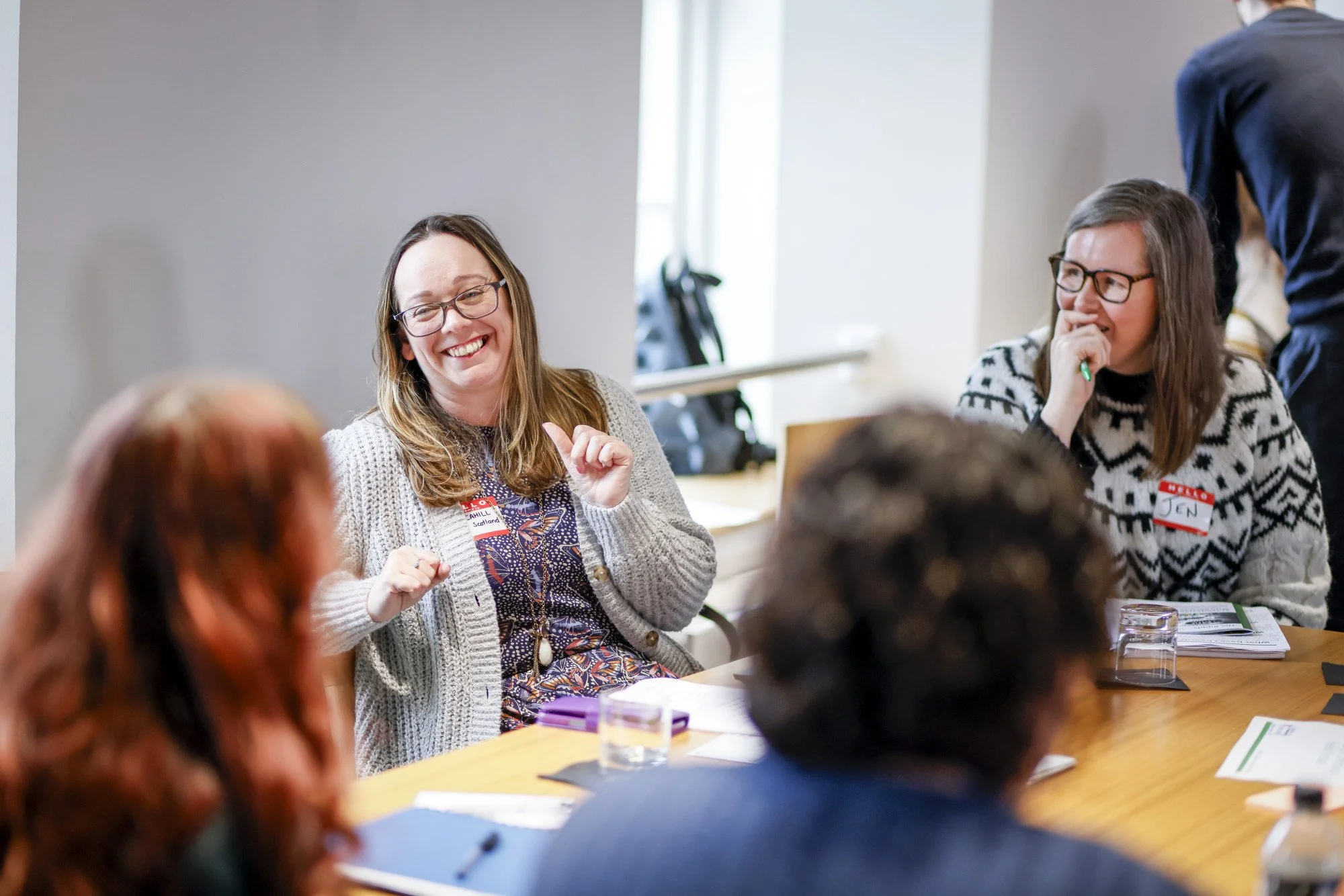
During the day, we hosted a series of world cafe inputs where participants to go hear about projects from across Scotland, ask questions and take part in discussion.
Clackmannanshire Transformation Hub
Norman Gill from Clackmannanshire Transformation Hub detailed the work they are undertaking to embed communities into how decisions are made and budgets spent. Bringing community members together into panels, they used their knowledge and lived experience to identify a vision for what change looks like focus area (e.g. homelessness). From there, public, third, and private sector partners offer solutions which are decided upon by the panel. This innovative model of decision-making has enabled community members, paid for their expertise, to set the direction of travel and influence how services carry out their vision.
The Ripple: Visualising complex data
Rachel Green from The Ripple Project in Edinburgh led a conversation about visualising complex data to make it both accessible and, at the same time, in order to challenge assumptions in that data. The Ripple, a long-standing community-led organisation in the Restalrig, Lochend and Craigentinny areas of Edinburgh, has worked with the Binks Hub at Edinburgh University to weave together the SIMD data for the local area. They then asked the community to design their own data for their area incorporating their lived experiences, both good and bad, to provide a lived experience model of where investment should be prioritised.
After Rachel’s brief input, participants shared learning and experiences around working with data in an accessible and effective way. There was agreement that creative and visual methods help bring data to life and reflect community priorities in a way that traditional methods struggle with. People often don’t identify with statistics about poverty and this is something people can relate to. One person commented that the tapestries were a “beautiful way of showing ugliness”.
Linlathen Local Fairness Initiative in Dundee
Here, Sheila McMahon from Dundee City Council (HSCP) shared with us the key success factors identified in the evaluation of the Linlathen Local Fairness Initiative in Dundee; a complex place-based intervention implemented in partnership with a wide range of stakeholders including members of the community. We discussed the importance of having a value – based steering group that had a shared understanding and involved local people from the beginning and throughout the process. Sheila highlighted how the new Integrated Logic Model produced by the multi-agency Engine Room involved many stakeholders in a dynamic process to capture a whole systems approach to tackling inequalities. We discussed what support the voluntary/ community sectors may need to fully participate in this type of data collection. This work is ongoing.
Collaboration is our superpower: How the third sector in Edinburgh fought back
Stephanie-Anne Harris and Magda Czarnecka from Edinburgh Community Health Forum described the work undertaken when sudden grant cuts threatened 64 long-standing community organisations in Edinburgh.
Stephanie-Anne described how the Forum, along with other key partners in Edinburgh, undertook a strategic and co-ordinated campaign that forced recognition locally that a vibrant and sustainably funded third sector isn’t optional – it’s essential to the City’s wellbeing. Stephanie-Anne described how the Forum, working with and on behalf of its members, were able to stop the cuts and are now working with the city council to co-produce a new funding model.
Magda, a member of the forum and CEO of Feniks, a local charity, gave a powerful insight into the human cost of uncertainty of funding and resources, detailing the impact on her organisation, people who rely on its services and the staff.