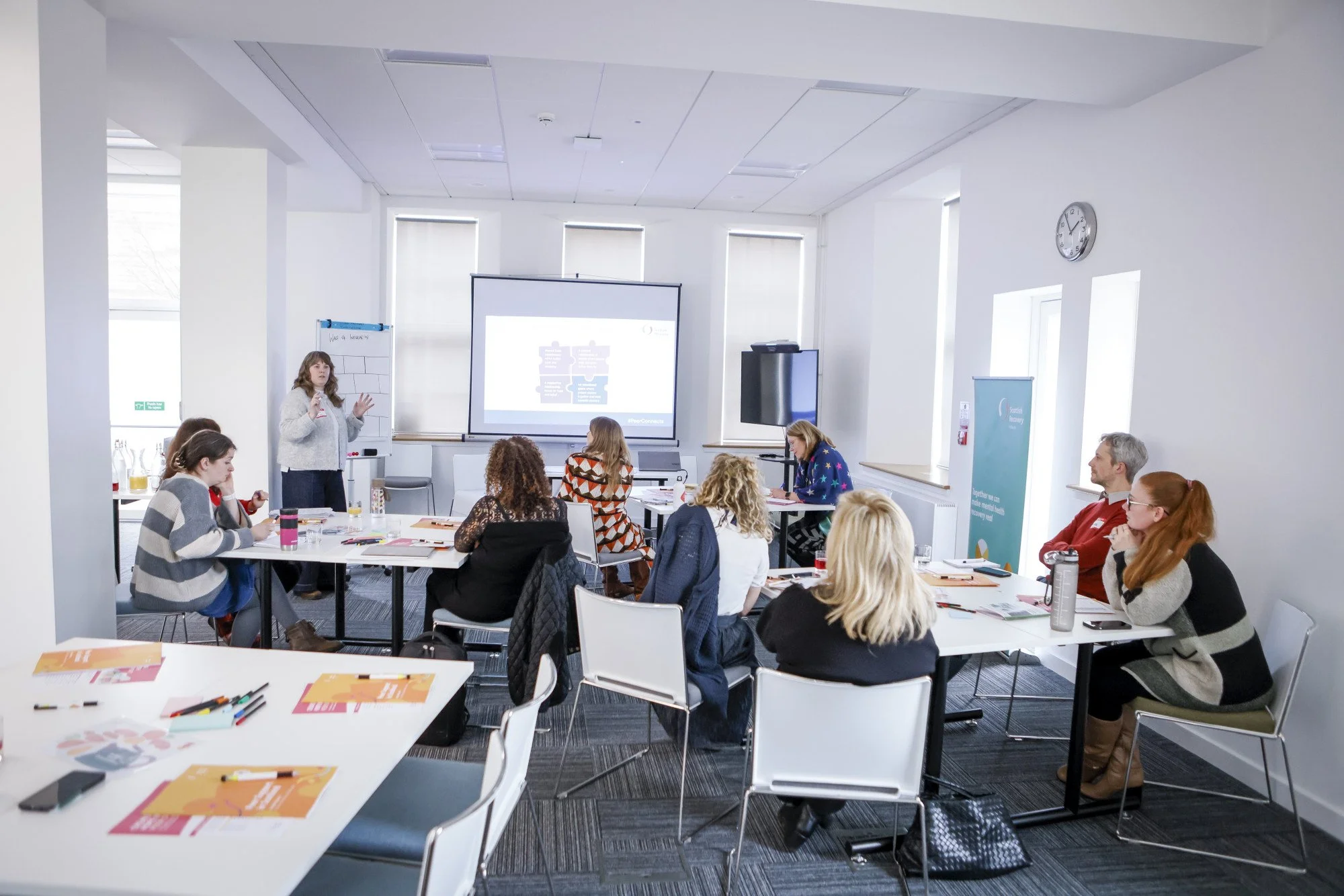
We were delighted to have workshop hosts who shared their knowledge and insight, opening up opportunity for reflections and discussion about their work
St Columba's Hospice & Marie Curie: Illness, caring, dying and loss: What can we do?
In this workshop, Roddy Ferguson & Helen MacGregor explores the role that palliative care plays in how we think about death, with the aim of moving us to a right to palliative care in Scotland.
We explored some of the personal experiences and stories of people who, due circumstances such as social isolation or poor housing, could not make the choices they wanted at the end of their life.
We also delved into some of the structural issues that must be addressed, and what can be done an individual, community, and societal level to ensure people are supported to make the right choices for them.
Roddy and Helen also shared information about the campaign for a right to palliative care in Scotland.
Scottish Recovery Network: The Role of Peer Support in Addressing Health Inequalities
In this workshop delivered by Eilidh Hollow from Scottish Recovery Network and supported by her colleague Lisa Moynes, participants explored the role of peer support in addressing health inequalities.
Eilidh introduced peer support as an approach, describing how it brings people together through shared lived experience, creating spaces where relationships are built on mutual understanding, trust, and respect. She emphasised how peer support recognises lived experience as a valuable form of knowledge, helping to shift power, strengthen people’s voices, and support greater choice and control in their lives. Across Scotland, therefore, peer support plays an important role in communities and organisations working to challenge inequality and support recovery.
After this helpful summary, the rest of the workshop time was given over to an exercise designed to enable participants to explore what peer support means in practice and how it contributes to community-led approaches to health and wellbeing. Eilidh asked workshop participants to identify a range of barriers which were then added to a ‘wall of inequality’.Groups were then provided with a set of prompts around what peer support brings, and asked to discuss how these helped to tackle health inequalities.
The session worked really well, and insights that were generated included: the role of peer support in challenging expert/patient relationships; how peer support gives people collective influence in challenging power; and, importantly, how peer support creates a safe environment for people to share their experiences and mutually support one another. Some interesting questions were raised as well, such what implications the different stages people will be at in their recovery journeys has on how peers support works in practice.
The session also created space to connect with others, share learning, and build relationships that support ongoing peer practice. The quality of the conversations generated was evident by hard it was to move everyone on for their lunch.
From Participation to Power. What CHAF is and why it matters?
In this workshop Community Health Advisory Forum members Dawn Cattachanach, Kelly Barnes, and Linda Smith shared the story of Dundee Community Health Forum, why it came about and how it creates change for individuals and communities affected by health inequalities in Dundee.
Supported by members of the Community Health Team, Kim Meek, Elaine Sword and Ria Rooney, explored some of the successes of the CHAF group including new groups and initiatives they deliver in the community such as the Menopause Cafes and Youth ASN group. They explored how they have developed their influencing role with Dundee Health and Social Care partnership through initiatives such as the Suicide Prevention Strategy and local health and wellbeing networks.
Throughout the workshop we discussed issues of power and participation, and the value of peer learning, networks and connections such as the partnership the CHAF established at last year’s CHEX Conference with Chance 2 Change in Drumchapel.
Upstream Prevention at a local level
This workshop explored how the global upstream prevention model of Planet Youth, currently delivering in 6 areas across Scotland) is being used to support local communities in Clackmannanshire.
A jointly delivered workshop by Janet Adam, Clackmannanshire Family Wellbeing Partnership, Tony McMinn, WASP Community Club and Lorraine Gillies, Planet Youth in Scotland.
Planet Youth is one of the world’s most successful, prevention models. Developed in Iceland and now used in more than 30 countries, it significantly reduces youth substance use, improves mental wellbeing, and boosts school engagement by reshaping the environments in which young people grow up.
The Planet Youth in Scotland Theory of Change shows:
The problem
What we aim to do to fix it
What we hope will happen as a resul